Thursday, 19 November 2015

Something about Three Rivers


"I've booked three nights in Trois-Rivières."  After days of dragging my feet over settling on the next step of my travel plans, I was ready to divulge them to my fellow German traveller in my hostel in Quebec City.

She wrinkled her nose in disdain.  "I think maybe that is too long." She said in reply.  "There is nothing to do there; you will be so boring [sic]."

Most people would be put off by an endorsement like that.  Me?  I immediately felt exhilarated at the challenge!  I think it is part of my mental programming.  If someone tells me how I should think about something or what I should do my first instinct is to do the exact opposite.  So, nothing to do in Trois-Rivières?  Excellent!  I will make my own things to do.  Nothing to see?  There are always things to see!  They just might require a little more delving and searching.  I might never see this person again, but privately I resolved to have a wonderful time in Trois-Rivières just to prove her wrong.  What a rebel I am.

"Why do you want to go to Trois-Rivières?" Another traveller asked, baffled by my choice in tourist destinations.

"Well, I remember hearing its name when I was in social studies in school, but I don't remember why it was important."  Okay, my reasoning needed a bit of work, I admit, but it was true nonetheless.  I wanted to go to Trois-Rivières because something in my very dimwitted memory reminded me that it was a very important place for Canadian history.  I couldn't remember any of the details except the name, so I wanted to use my trip to remind me in a tangible way why the city was important, despite how trivial the other travellers around me seemed to considered it.

The first day in Trois-Rivières I decided to do a tour of the downtown sites.  I was done in a couple of hours. There was a boardwalk by the Saint Lawrence river that was quite beautiful, a few sculptures scattered around a park, a bunch of information panels written only in French (though later on I found I could scan a code with my cell-phone to get the English version of a lot of them), a free-to-use piano in a public city square and a giant light-brite in the local library (!!!!!).  A large portion of the city had been destroyed in a massive fire near the beginning of the 20th century so there were very few old ornate buildings left in place.  With so little tangible history present it was hard to believe that this was the 2nd oldest settlement in Canada, right behind Quebec City, and the site of a very important battle during the American Revolution that was key in preventing Canada from being absorbed as another state in the new United States of America.   Rather than finding a proud bustling metropolis befitting of such an important status, what I found was an endearing sleepy little city who embraced its history like a true Canadian: modestly.

And yet, despite the lack of tourist-centric organized activities that I probably wouldn't have paid for anyways because I'm so cheap, I found myself deeply captivated by the place.  Borrowing a bike from the hostel was free so I spent hours exploring the city.  I found out that the reason that it is called Trois-Rivières, Three Rivers in English, is because the river that feeds into the Saint Lawrence splits into three right before reaching it due to islands that interrupt the flow.  Those same islands gave me photo opportunities like this one that I took with my iPhone:


I also had the opportunity to go to a very key pilgrimage site for the Roman Catholic church, Notre-Dame-du-Cap, with a local francophone.  We attended a French mass where I didn't understand a single word, except "etre le premier".  Wracking my memory on what place in the Bible has the phrase "to be first", I correctly identified the passage of scripture that the homilist was using for his address. I managed to impress myself with that feat, I admit.  The grounds of the basilica were so beautiful that two days later I would revisit them to spend more time there.


There were a bunch of other things I did in the city while I was there, but what stands out in my memory is just how relaxing I found my time in the small city.  Without so many touristy things demanding my attention I was able to slow down and soak in the experience of this place called Trois-Rivières.  The food was super cheap too, so I bought groceries and ate like a queen during my entire visit there.  Despite the negative endorsement from my fellow travellers, I had found what I  already expected to be true: that the excitement and interest of a place is what you bring to it, not what it can bring to you.

Wednesday, 18 November 2015

Something not so imaginary

  
Imagination is a wonderful thing.  It makes real-life mundane situations way more exciting than they actually are.  Take the picture above, for example. The purpose of taking this picture was to tell a story that was not even happening.   The setting invokes a sense of desolation, isolation and danger.  My posture in the picture suggests that  I am being hunted  and am on the run, or am lost and confused, or was taking an innocent walk when a forest of dead trees suddenly surrounded me, invoked by the dread warlock Horrifus.  In this moment I must gather my resources and wits to secure my survival. I must choose between fight or flight - else all might be lost!
 
Alas, reality was not so interesting.
 
The truth is, I was taking an innocent walk, but with a group of people on the Cabot Trail in Cape Breton Island, Nova Scotia.  We were on the Middlehead trail, taking in fantastic views of the Atlantic ocean when we came upon this forest of dead kindling along our path.  Our steps faltered for a moment as my friend spoke what was on all of our minds, "Now, this is spooky."  Inspired by his statement, I quickly set up my camera, shoved it into his hands and told him to take a picture of me in the trees.  Voila!  Setting captured, story told!
 
Sometimes it makes me sad that reality is not as exciting as our imaginations can be.  That walk we took along Middlehead trail was very pleasant and enjoyable, but nothing as stimulating as being attacked by the dread warlock Horrifus happened on that journey.  Then again, I should be grateful that is the case.  This past week the people of Paris, France went through a situation that I am sure they wish was imaginary - the fodder for action-adventure movies or evocative photographs telling a fictional story.  Seven coordinated terror attacks on French civilians in public places killing 129 people.  Suddenly what was always considered safe was no longer so.  The stories that had been read in news about other people in places like Syria, had suddenly become the people of France's own reality.  The imaginary had come to life.
 
The worst thing about the imaginary becoming real is that the sense of control we had when the event was solely confined to the imagination is lost.  No longer are we able to be fit and mould events into a narrative that leaves us as the heroes of the story.  When the imaginary becomes real, instead of being the heroes, we fall into the role of victims.  Worse, we no longer know what to define as reality, so we begin to accuse innocent people, who are trying to flee a similar terror, of being the same as the terrorists who attacked us.  We try to take control of the story by initiating a counter-attack, becoming aggressors in our own right.  This is not a video game though.  Here counter-attacking means the loss of real lives, sometimes innocent lives.  Even as we take up arms to be the heroes in our own eyes, we become the villans in others.  Reality is not as simple as the imagination and there is no game guide to get us through it. 
 
In our reality the fight or flight response is the natural human reaction to a situation like this.  It takes a lot more imagination to find a positive alternative for our historical narrative. What irony that it is when we can no longer separate the imaginary from reality that we need our collective imaginations more than ever!  This is the time when we all need to individually ask ourselves this question: how do we as a people take control and start shaping a narrative that is actually heroic, where aggression that breeds aggression is no longer a dominant theme in the world story we are telling? 

Sunday, 15 November 2015

Something smokey

August 28, 2015:

The boarding area of the airport is crowded with people.  Apparently the planes are having trouble landing because of the smoke.  Forest fires in BC are nothing new for us, but this is the first time in recent memory that it has been this bad this close to home.  I had been riveted to my computer in terror only a few short weeks earlier as I watched videos online of people running for their lives from an encroaching wall of flame that was only about a two and a half hour drive from my hometown.  My mother grew up there.  That's definitely too close for comfort. 

The fires surrounding the region have placed their claim on the sky.  The smoke is thick and oppressive; it blankets and conceals the mountains in a dull monotonous grey.  The thin pale light that has managed to fight its way to earth gives everything it touches a washed-out and dreary appearance.  This atmosphere gives off the impression that we are in a war film, and that is not too far off I suppose.  Really, a forest fire film would make a great thriller movie - along the lines of Volcano and Daylight.  It's exactly the type of movie I hate to watch (and would hate even more to be in), because everyone but the hero dies at the end.  Depressing.  Just like the smoke.

I had taken a picture of the smoke on my way to Calgary only a week earlier.
A sense of anticipation fills the airport.  People, like me, are eager to leave.  Daydreams of smokeless horizons are dancing on the edges of our collective consciousness like sugar-plum fairies, and we are already envisioning our first deep breath of clean fresh air away from the fire-ridden BC interior.  My destination: Halifax, Nova Scotia.  I am about to embark on an extended journey to Eastern Canada to explore what the far eastern reaches of my country have to offer in the way of discovery and adventure.

I successfully made it through the luggage check without getting searched, to my jubilation, since everything thing I need for the next two months is currently jammed into the backpack on my back.  I am not used to the weight of my bag, though, so I want to sit down.  I spy a few empty chairs and unceremoniously plop my stuff down.  I raise my eyes and look for my travelling companion who will be joining me for the first few weeks.  There he is - he has just finished filling his mug with water and is searching for me.

"JOSH!" I call raising my voice to just under a yell, simultaneously not only catching his attention but also making the poor soul sitting in front of me just halfway out of his seat in pure terror.  He whips around, eyes wide, as though looking for the she-devil herself.

"Sorry", I give him a sheepish smile, "your name must also be Josh."

And just like that some of the tension in the airport is broken, as everyone around us gets in a good laugh.  For a moment fires cease to matter, and we all get to share in the amusement of what a small world it is that more than one person in the same place can share the same name.  I may not be good at fighting fires or surviving to the end in thriller films, but least I can provide the comic relief.

The sky in Halifax was as clear as I had hoped it would be when we arrived.

Saturday, 14 November 2015

Something about the Canadian dream

"There is no Canadian dream." I read this statement yesterday in an article quoting Ben Carson as he praised American exceptionalism in his bid for Republican presidential nomination in the States.  I almost snorted out loud in the coffee shop where I was perusing my facebook page.  What ignorance!  Anyone who makes that sort of statement obviously does not know Canadians very well.  This sort of person makes the assumption that Canadians prefer mediocrity, when the fact is the Canadians just happen to value modesty as much as we also value our own awesomeness.  Canadians have a lot of pride and a lot of aspirations - we just don't talk about or flaunt them as the Americans do.  There is a Canadian dream, but it is not something advertised or blown out of proportion.  It is something lived and something that is an innate part of us.  Anyone who spends any time living with Canadians will begin to get the sense of how this dream permeates our society.


In fact, recently in a write-up for a women's conference that was discussing the different experiences a woman faces through the decades of her life, I took a moment to ponder the Canadian dream:
"When I was a teenager I put a lot of thought into my 20s. To me they were golden years of opportunity where I would be able to figure out the mysteries of life, the universe and everything. I would decide what I wanted to do as a career, get a college or university education then use that as the foundation to launch the rest of my life. I figured I would get into a serious relationship around the age of 21, maybe get married at 23 or 25. I would graduate from university in my early 20s, be set for life and start raising a family. It was the typical all-Canadian dream."
The thing that stands out for me in my summary of what the typical all-Canadian dream looks like, is that it focuses on education, on family and on finding a productive and meaningful place in society.  These focuses differ some from the American dream, and these differences become apparent when one starts to compare prevalent political ideologies between the two nations.  Proud socialists, Canadians value education - which is why we promote and fund our public schools and Colleges better than the States. We value family which is why we have universal health care, subsidies for parents with children, and paid maternity leave.  We value finding a productive and meaningful place in society, which is why topics like environment & climate change, science, and social justice have been such huge themes in our recent elections.  American politics, and consequently the American dream, focuses more on capitalism - the opportunity to gain wealth through free enterprise.  Canadians value this too, but possessions and financial success are often mere by-products of our larger dream.  And this approach has worked for us, as this article from 2014 bluntly states.

So, Mr. Carson, I am afraid you are dearly wrong.  Canadians have a dream.  It is a wonderful dream and it is a modest dream. It is a dynamic dream that we are not afraid to shape our society around.

Friday, 13 November 2015

Something to be remembered

Once when I was in my early 20s and my sister was still in her early teens she came to visit me in Calgary.  I had all sorts of exciting shenanigans planned for her visit, but knowing we couldn't possibly fit them all in I decided to give her the opportunity to choose an activity from among them.

"So, what would you rather do this weekend - ," I asked, "go to the museum or zoo?" Yeah, my shenanigans were that exciting. I had a secret wager with myself that she was going to pick the zoo, after all - cute, cuddly animals that you don't have the opportunity to see every day - how could you not?  In truth I really wanted to go to the museum but I seriously doubted how a feature exhibit on the building the trans-Pacific railway could possibly stimulate a 14 year old brain.  My sister surprised me though when she picked the museum, almost without a second thought.  Oh yeah, I remembered, we are sisters.  Strange things like preferring museums to zoos must run in the family.

When I was travelling in Eastern Canada I had the opportunity to visit my fair share of museums. In fact, at one point in Montreal I reached a point of museum overload when we visited the Place de Calliere, Planetarium, Biodome, Musee de Marguerite Bouregoys, Centre d'Histoire de Montreal, Bank of Montreal money museum, Chateau Ramezay and a few other places I have already forgotten all in the matter of a couple days!  My journal entry from October 1st reads, "Yesterday: too many museums."  That's it.  That's all the energy I had to write!  My brain was so fried that by the time we got to the Musee des Hospitaliares I was doing that thing where you read a sentence, get halfway through and realize you don't have any clue what it is saying so you start reading from the beginning again only to get 1/2 a dozen words in before you realize you can't even recall what they were, so you start again and the vicious cycle repeats itself.  I ended up giving up at that point.  Apparently there can be too much of a good thing.  The good news is: I recovered.  By Ottawa I was prepared to visit museums again, only no more than one a day this time.

The thing about going to so many museums is that you begin to see how they have a tendency to be all the same.  Take First Nations exhibits, for example.  By the end of my trip I was getting seriously annoyed with them.  I voice my frustrations in my journal:
"Canadians seem to think that this is our history, but the truth is that it is us trying to record the vestiges of a dying culture because our ancestors nearly stamped them out of existence.  How many museums have I entered that have told me what the First Nations did, what they wore, how they survived, but have never told me who they were? There is almost never a story of a person, of a soul that represents the soul of his or her people, and that is the real tragedy of these museum exhibits.  History remains a white man thing - with the remnants of the civilizations we have conquered displayed in our halls."
There were exhibits, however, that offered a fresh perspective that I really appreciated.  In the Canadian Museum of History I went through an exhibit entitled "1867: Rebellion and Confederation."  This exhibit told the story of the context surrounding Canada's confederation, about how the American revolution to the south had pushed up the British loyalists who had a superiority complex over the French Acadians and the only reason these two cultures completely at odds with each other came together was because they were worried about being annexed by the States. I found it extraordinarily amusing that the origin of Canadian identity was in the desire to NOT be American.  Despite our close ties to the US today, this one fact remains a pivotal expression of Canadian identity.

What I really pulled away from the 1867 exhibit, however, was the fact that when Canada became a nation, it was in fact not a nation.  People in Canada still thought about themselves as British subjects.  They still carried British Passports.  It wasn't until World War I, as I learned later at the Canadian War Museum, that Canada was recognized on an international stage as its own unique country.  It was because of World War I that Canadians decided to take over their own international affairs, that we began to take pride in saying that we were Canadian and began to seek out symbols of our cultural identity. 

A few days ago we celebrated November 11th, Remembrance Day here in Canada.  That day I had the opportunity to help my church serve coffee and hot chocolate to the hundreds of people who came to participate in the ceremonial process of remembrance and I did not hesitate to take a few pictures.  War is a tragedy.  It has a huge toll in the cost of life that it demands.  And yet, I feel so grateful for those soldiers and people who have represented Canada in war.  At the museums I visited on my trip I learned that the adversity of war is what helped birth our national identity.  We are not a warlike people; we have not sought conflict as the Americans have throughout their revolutionary history.  But it is through the fires of war that we have discovered who we are and what we believe in as a nation.  It is because of the sacrifices of these people that we can have pride in being Canadian.

For that, soldiers and veterans, I thank you.

Wednesday, 11 November 2015

Something political (part 3)

Who knew an election could be so lively? I had never been anywhere public to watch the national election results before, but the hum of energy in the theatre where I am sitting is tangible.  For a moment I regret that I am unable to hear the election coverage commentators over the myriad of conversationally engaged people around me.  But then I realize that not only can I still see the important stuff on the screen, but the ebb and flow of voices from the theatre are providing their own unique commentary. 


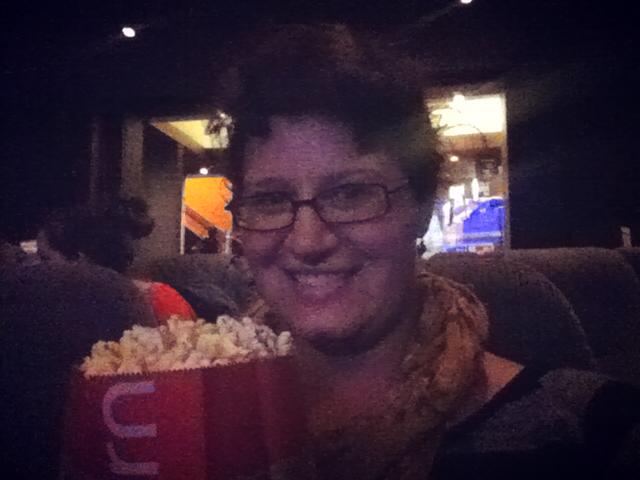
IPhone selfie with my popcorn!
The NDP* get a seat! They cheer! *New Democratic Party

The Liberals get a seat!  They cheer!

The Conservatives get a seat!  They boo!

A Conservative cabinet member gets upset!  The Liberal party wins the seat.  They cheer! LOUDLY.

An NDP member gets upset.  The Liberal party wins the seat.  There is a mixture of both disappointment and acceptance.

I take this all in and feel a tickling sense of amusement.  Just by the responses alone it is not hard to tell that I have found myself in the midst of a young vocal university crowd, a demographic that is notorious for being left-leaning.  I suppose it should be no surprise, as the cinema is in the middle of the University district of Toronto, but the unabashed vocal engagement of the crowd gives the sense that we are just as engaged in the results of the federal election as we would be in an epic Canadian hockey game! 

~Cue hockey announcer voice~ "That Liberal came out of nowhere, straight down centre ice.  It's a breakaway!  He shoots, he scores!  It's a Conservative upset!!!!" ~Cue massive fan cheering~ 

Olivia Chow, widow of the late Jack Layton former leader of the NDP, gets defeated.  Suddenly the deafening hum of voices in the theatre go silent all at once.  You could hear a pin drop.  The silence speaks volumes and you feel how stunned, sad and full of respect the population of the theatre is for her.  Coverage switches to show Olivia giving her concession speech and the crowd around me remains silent, listening intently for the duration of the speech.  Then the election results resume, and just as though someone flipped a switch, suddenly the voices pick up where they left off, robust as ever, drowning out the sounds of the television announcers.

It's only about 20 minutes after the polls in Ontario and Quebec when a message flashes across the screen LIBERAL VICTORY.  The voices in the theatre falter and I can hear the announcer on tv saying, "The analysts are calling it a Liberal victory.  The Liberals will be the ones to lead our next government."  Confusion rolls through the stunned theatre.  "What?" I can hear a dozen voices saying, "Isn't it way to soon to be calling this?"  After all, only a handful of ballot boxes in our most populous provinces have been counted.  I myself am skeptical and think that the guy sitting next to me is summarizing the situation perfectly, "Well, they better hope they are right or this is going to be the biggest embarrassment of Canadian news reporting history!"

It turns out the analysts were not wrong.  As the night goes on, the red Liberal wave sweeping the nation become apparent.  It is not even an hour later when the announcers update their announcements.  It will be a Liberal majority and the Conservative party will form the official opposition.  I find myself breathing a sigh of relief at the word "majority".  To me this means that the new government can be effective.  They  don't have to get caught up in trying to negotiate between warring factions, and they will have a chance to prove themselves, 4 years to be exact.  In the meantime Canadians won't have to return to the polls right away and we will have a chance to observe and see whether these politicians will live up to their promises.

The Canadian government before the 2015 election:
Conservatives 166  NDP 103  Liberals 34  Bloc Quebecois 4  Green 1

The Canadian government after the 2015 election:
Liberals 184  Conservatives 99  NDP 44  Bloc Quebecois 10  Green 1
(This is a massive change in government.  The Liberals gained 150 new seats).

As the night concluded and I went back to the hostel dorm to watch the after-election commentary on the internet until 3 in the morning (for the first time on my trip missing my BC time zone which meant I would have gone to sleep at midnight instead of 3am), I had only one thought go through my head:

A new government, a Blue Jays win, and a Star Wars trailer - it was truly a great night to be Canadian!

Canadian Parliament Buildings framed by the Canadian Museum of History


Monday, 9 November 2015

Something political (part 2)


It's already dark as I step out from the Toronto subway.  There is a hum of energy around as people walk down the sidewalks with purpose.  This is probably typical of Toronto, but for a moment I allow myself the illusion that they are headed to their destination with the same purpose I have: to imbibe on a refreshment of their choice (in my case popcorn, oh what a party animal I am!) and watch the election results.  I orient myself on my phone using the Google maps app and set out in the direction of the cinema.

There is a greeter at the door when I arrive.  I mention I am there to watch the election results and a big grin lights up her face.  "Welcome!" she enthuses as she quickly gives me an orientation on where I can buy my popcorn.  Popcorn: very important for an election night - I am glad that she recognizes this.  I walk to the popcorn line, which is empty.  I've arrived over 20 minutes early, being the keener I am, so that is no surprise.  I look at the sign on the cashier's desk.

MEDIUM POPCORN
$3.38
(The number of seats in the House of Commons)
 
FREE REFILLS!
 
Excellent, this night was starting out excellent!  I swiftly purchase my popcorn, yes extra butter please, and then I go pick out a seat in the sparsely populated theatre.
 
I am surprised to see that the screen is already on and election results are rolling in from the Maritimes.  A few of the ridings are being slightly schizophrenic, tumbling between a Liberal/Conservative identity crisis, but otherwise the Atlantic provinces are looking decidedly red.
 
Very little happens for the next 40 minutes.  I watch the commentary that the political analysts are providing on the tv as the Maritimes decide that they are going to be 100% Liberal after all.  The seats in the theatre around me fill up. A dull roar from the hum of voices surrounds me, it is becoming increasingly difficult to hear.  On my left a young couple settles down in their seats and pulls out their refreshments, a clear liquid in a soda bottle that is definitely not water and plastic cups to drink it with.  We chat a bit about our anticipations for the evening and he offers me something to drink from the bottle.  Nah, I'm happy with my popcorn, but thank you.  On my right three young girls of east Asian descent who look like they are barely out of high school and old enough to vote sit down.  They chatter loudly, enjoying their own refreshments, holding pieces of paper in their hands. I glance at the piece of paper "Election Bingo" it says.  HOLD THE PHONE! The cinema is giving out Election Bingo and I didn't get one?!  I briefly consider whether it is worth it getting up to hunt down my own piece of paper, but then I consider the swelling theatre population and decide the effort isn't worth it.  I like my seat too much.  Maybe I'll get one when I go for a popcorn refill.
 
The stage is set, my first helping of popcorn is almost finished, and there are only 10 seconds before the polls in Quebec and Ontario close.
 
"10 - 9 - 8 - 7 - 6 - 5 - 4 - 3 - 2 - 1."  The dissonant hum of voices unites into a singularity of anticipation and cheers echo as the announcer on the tv declares that the polls are now closed.  Now things get interesting.